 $NAT · Adam Back, answered
The security-budget explorable · companion page

Adam Back vs $NAT
On the security-budget thesis.
AUG 12, 2025 the thread
12 replies
4 claims
4 answers
1 live model
300+ days standing
In August 2025, Adam Back, the inventor of Hashcash and one of the most credentialed
cryptographers in Bitcoin, replied twelve times to the $NAT security-budget thesis. It is the most serious dismissal
this project has received, and it deserves a serious answer. His words below are quoted verbatim and unedited.
Each answer is a live scenario you can run yourself.
his claim
the model's answer
01The price will outrun it
EXHIBIT A
Adam Back
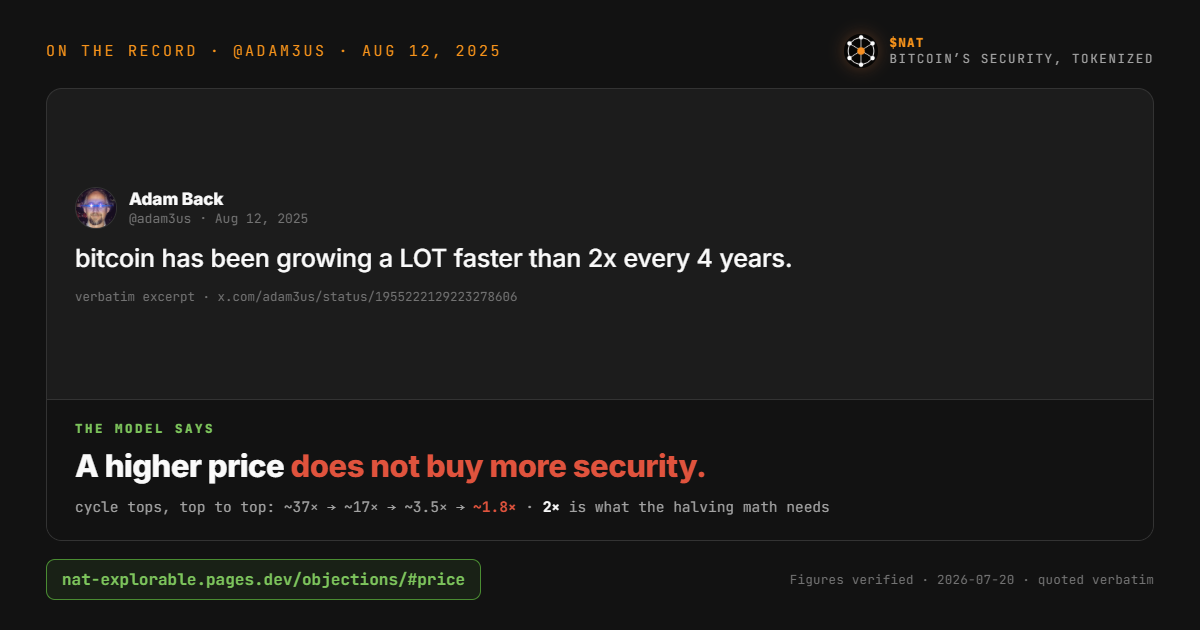
bitcoin has been growing a LOT faster than 2x every 4 years.
Translation
Quoted verbatim and unedited.
Posted 2025-08-12 10:57 UTC · timestamp decoded from the tweet id
Screenshot + full-thread JSON on file
Posted 2025-08-12 10:57 UTC · timestamp decoded from the tweet id
Screenshot + full-thread JSON on file
The model says
~37×2013→
~17×2017→
~3.5×2021→
~1.8×2025
cycle-top multiples, top to top · 2× = what the halving math needs
Top to top, the cycle multiples have fallen every cycle since 2013. 2025 was the first top under
the 2× the halving math needs. But suppose the trend reverses. The bull-case scene grants the Power-Law
price in full, and security's share of Bitcoin's value still decays toward ~0.006%.
A higher price does not buy more security. It raises the value the thinning budget must defend.
Reply with this1200×630 · quote + answer + link
click to view full size ↗
click to view full size ↗
02Solutions already exist
EXHIBIT B
Adam Back
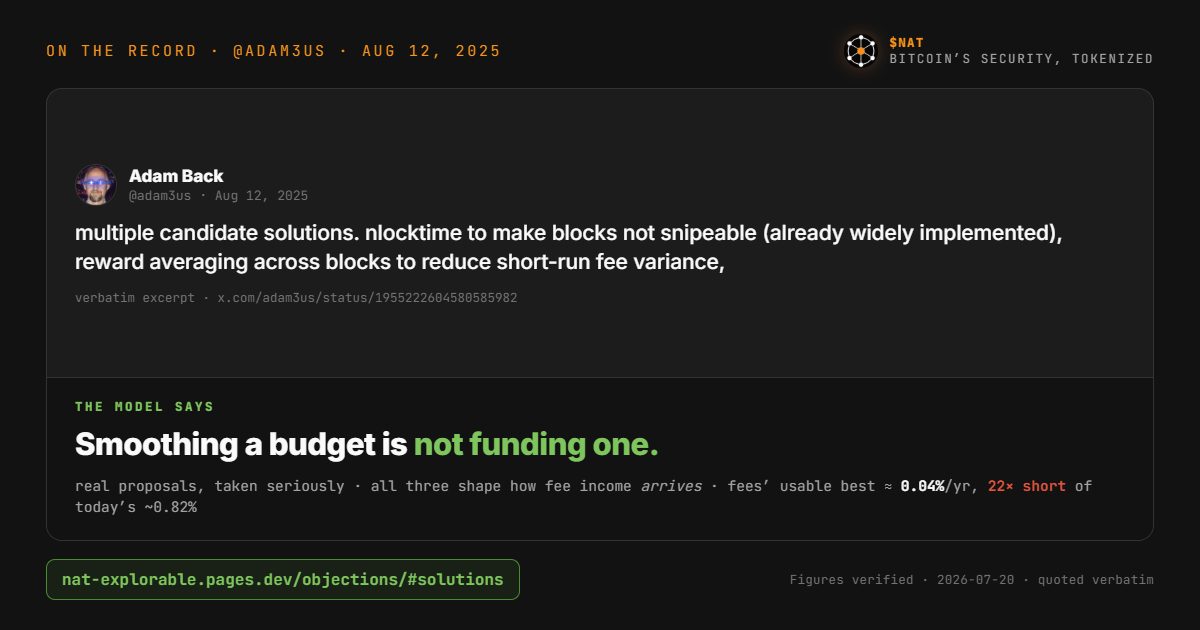
multiple candidate solutions. nlocktime to make blocks not snipeable (already widely implemented), reward averaging across blocks to reduce short-run fee variance,
Translation
Adam Back
I proposed some years back: ASICs that won't go backwards - enforce the arrow of blocktime in hardware, refuse to mine lower block height than they previously mined.
Translation
Quoted verbatim and unedited.
Posted 2025-08-12 10:59 UTC · timestamp decoded from the tweet id
Screenshot + full-thread JSON on file
Posted 2025-08-12 10:59 UTC · timestamp decoded from the tweet id
Screenshot + full-thread JSON on file
The model says
today's security spend
~0.82% of BTC value / yr
~0.82% of BTC value / yr
fees' usable best
~0.04% / yr 22× short
~0.04% / yr 22× short
the level his fixes never touch · smoothing a budget is not funding one
These deserve to be taken seriously: they are real proposals from serious people. All three shape how
fee income arrives. None of them adds a satoshi to what miners are paid. Anti-sniping and reward
averaging redistribute the same thin fees. Hardware rules pay nobody. The question they leave untouched is the
level: fees' usable best is about 0.04% of Bitcoin's value per year,
22× under today's ~0.82%.
Smoothing a budget is not funding one.
Reply with this1200×630 · quote + answer + link
click to view full size ↗
click to view full size ↗
03Premature worrying about non-problems
EXHIBIT C
Adam Back
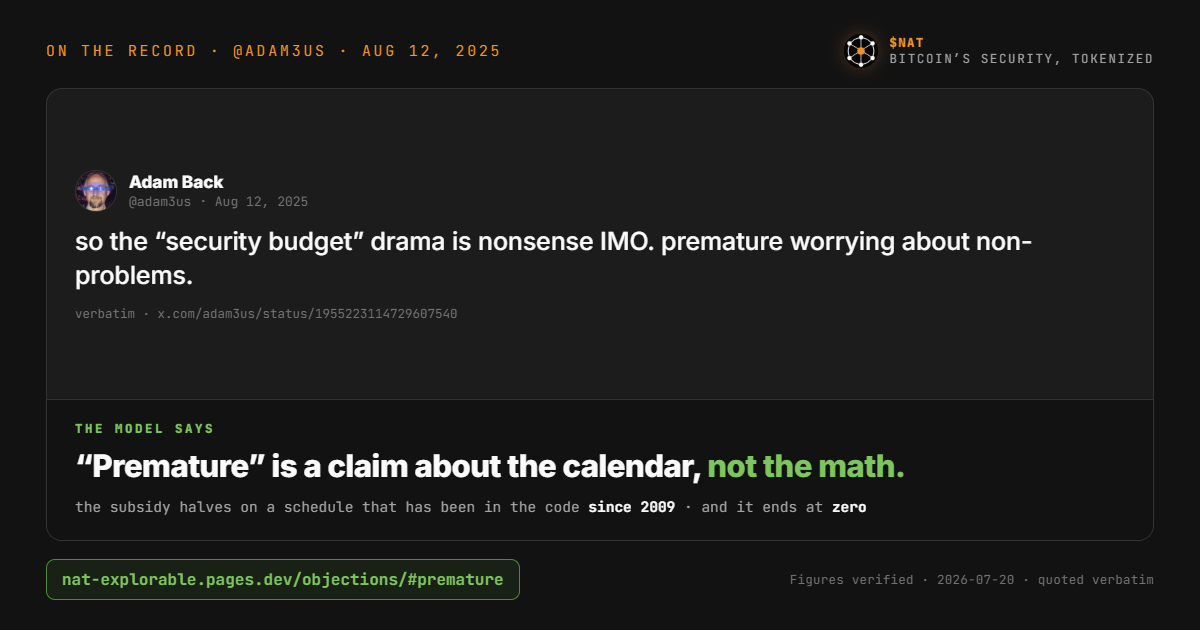
so the “security budget” drama is nonsense IMO. premature worrying about non-problems.
Translation
Quoted verbatim and unedited.
Posted 2025-08-12 11:01 UTC · timestamp decoded from the tweet id
Screenshot + full-thread JSON on file
Posted 2025-08-12 11:01 UTC · timestamp decoded from the tweet id
Screenshot + full-thread JSON on file
The model says
$0
2012’16’20’24’28’32’36…2140
block subsidy per halving, to scale · in the code since the 2009 genesis release
“Premature” is a claim about the calendar, not the math. The subsidy halves on a schedule
that has been in the code since 2009, and it ends at zero. The strongest version of his position is not “there is no problem.”
It is: the problem is old news and the mitigations are ready. The two scenes above test exactly that, and
the mitigations never touch revenue. Drag the year slider and pick your own definition of premature.
Reply with this1200×630 · quote + answer + link
click to view full size ↗
click to view full size ↗
04It's an airdrop, presumably pre-mined
EXHIBIT D
Adam Back
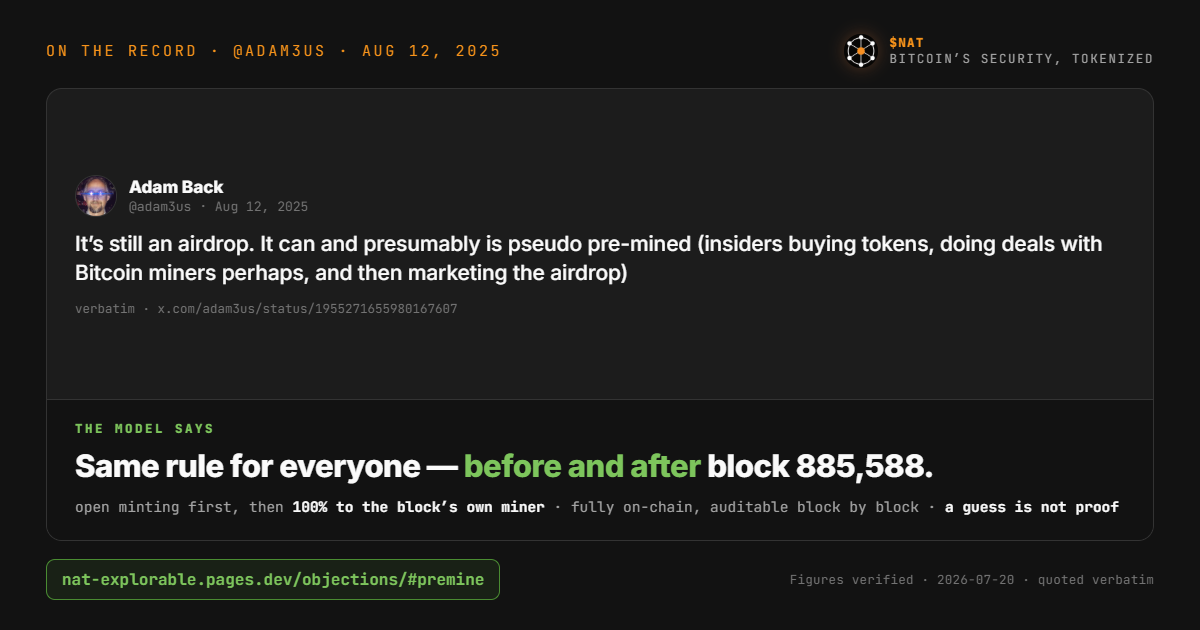
It's still an airdrop. It can and presumably is pseudo pre-mined (insiders buying tokens, doing deals with Bitcoin miners perhaps, and then marketing the airdrop)
Translation
Quoted verbatim and unedited.
Posted 2025-08-12 14:14 UTC · timestamp decoded from the tweet id
Screenshot + full-thread JSON on file
Posted 2025-08-12 14:14 UTC · timestamp decoded from the tweet id
Screenshot + full-thread JSON on file
The model says
✓emission is deterministic: every block mints its bits value as $NAT
✓since block 885,588 (Feb 2025), 100% of it goes to the miner of that block
✓before the redirect: open minting, same rule for everyone, fully on-chain
auditable block by block · a prior is not a finding
“Presumably” and “perhaps” are priors, not findings. And the prior is
reasonable: it fits thousands of altcoins. Early participants accumulated cheaply. So did early Bitcoin miners.
The difference between a premine and an early adopter is whether the rule was the same for everyone.
Here it was, and the chain is public. Check whether the prior fits this one.
Reply with this1200×630 · quote + answer + link
click to view full size ↗
click to view full size ↗
The standing invitation
If the math is wrong, the fastest way to end the “drama” is to show where.
Every number on this page is computed from the same public model, and the sliders are yours. The invitation stands.
Every answer here also ships as a postable card — the Reply Arsenal →
$NAT · security-budget explorable
Quotes verbatim · tokens only · not a forecast